AI agents are becoming increasingly capable of completing multi-step tasks, selecting tools and acting across business systems. Yet the difference between an impressive demonstration and a dependable production system is not simply how intelligently an agent can reason. It is whether the organization can see what the agent is doing, control what it is allowed to do and recover when an action goes wrong.
That distinction matters because an agent does more than generate an answer. Once connected to enterprise data and operational tools, it may update a customer record, trigger a workflow, create a support ticket, modify code or initiate a transaction. A weak answer can be corrected. An incorrect action may change the state of a real system before anyone notices.
For organizations moving from experimentation to deployment, the central question is therefore changing. It is no longer only, “Can the agent complete the task?” It is also, “Can we trust the system around it?”
The gap between a successful demo and a reliable system
Agent demonstrations usually take place in controlled conditions. The task is clearly defined, the data is limited and the available tools have been selected in advance. Success is often measured by whether the agent reaches the expected outcome.
Production environments are much less predictable. Inputs can be incomplete, permissions change, APIs fail and business rules conflict. An agent may encounter information that was never present during testing or receive an instruction embedded inside a document, webpage or tool response.
This is why model accuracy alone is an incomplete measure of production readiness. A production agent must operate within an architecture that can answer four additional questions:
- What information and instructions influenced the decision?
- Which tools and permissions were used?
- Was the action within the agent’s authorized scope?
- Can the action be stopped, corrected or reversed?
The growing focus on these questions can already be seen in emerging industry standards. The OWASP Top 10 for Agentic Applications identifies risks such as agent goal hijacking, tool misuse, identity and privilege abuse, and unexpected behavior. These risks arise not only from what a model says, but from what an agent is empowered to do.
Autonomy creates a new operational surface
Traditional software follows predefined execution paths. A developer specifies which conditions lead to which actions, and the application behaves within those boundaries. An AI agent introduces another layer: it interprets a situation, develops a plan and selects the next action dynamically.
That flexibility is what makes agents valuable, but it also expands the operational surface that teams must manage. The same agent may behave differently depending on its context, retrieved information, available tools and previous interactions.
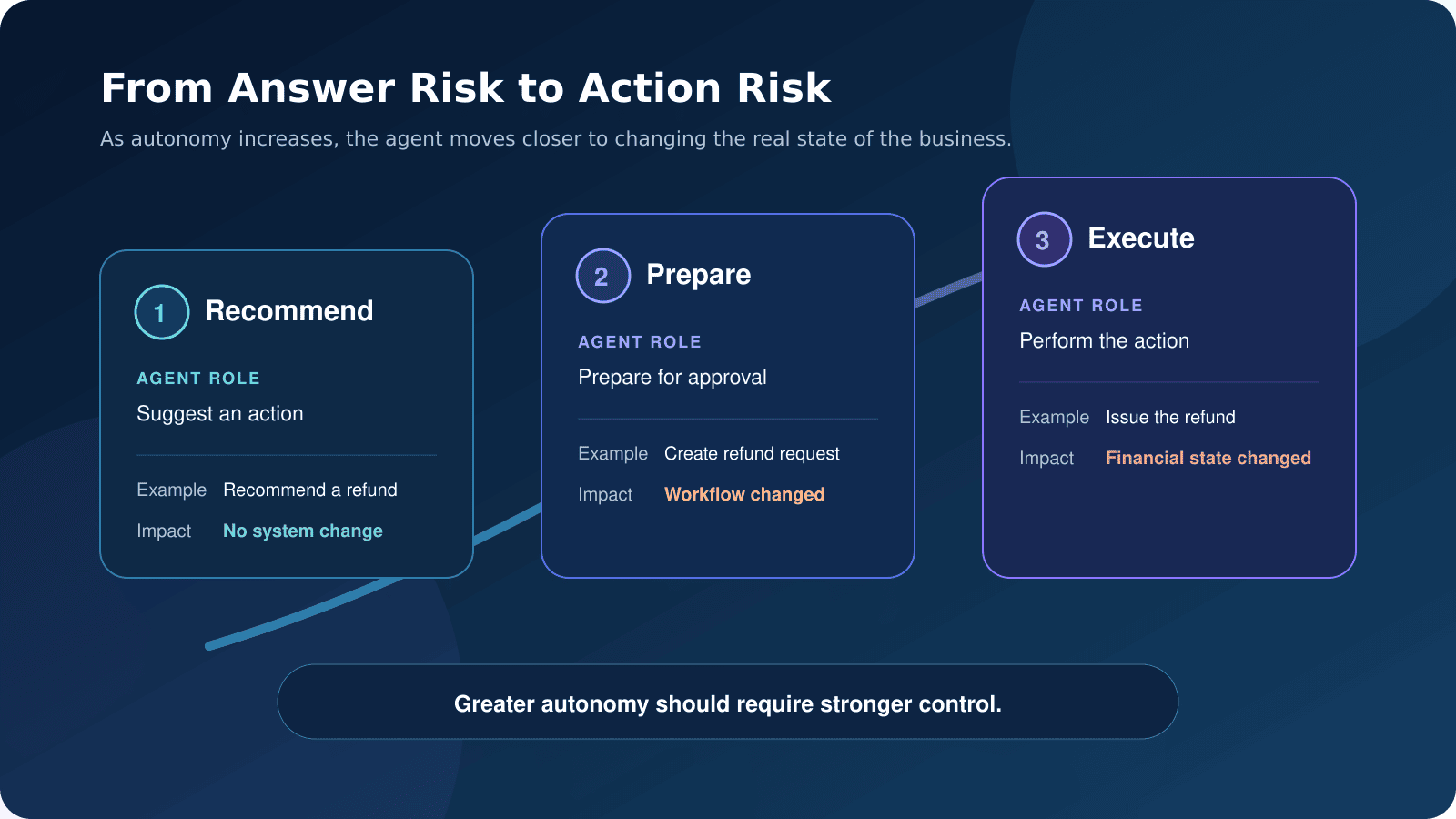
Consider a customer-service agent connected to a CRM and billing platform. It may be able to summarize a complaint, retrieve an order and recommend a refund. Those tasks carry different levels of consequence. Summarizing information is relatively low risk. Preparing a refund for review changes the workflow. Issuing the refund directly changes the company’s financial records.
Treating all three actions as one category of “agent capability” obscures the real design problem. Production readiness depends on matching the agent’s authority to the consequence of each action.
A practical model separates agent activity into three levels:
- Recommend: The agent analyzes the situation and proposes an action.
- Prepare: The agent completes the necessary work but waits for approval.
- Execute: The agent performs the action within a defined scope.
This allows autonomy to increase gradually. It also gives product and engineering teams a clearer way to decide where human judgment remains necessary.
Visibility: knowing what happened is not enough
Conventional application monitoring typically records requests, errors, latency and infrastructure health. Agent systems require a richer form of observability because the execution path may be assembled dynamically.
On July 23, 2026, AWS introduced unified observability for Amazon Bedrock AgentCore, bringing an agent’s traces, prompts and structured logs into a single per-agent log group. AWS specifically positioned this as a way to correlate execution history, apply more precise access controls and debug multi-agent systems end to end.
OpenTelemetry is moving in a similar direction. Its semantic conventions for generative AI aim to standardize how model operations, tool calls and agent activity are represented across observability systems.
These developments reveal an important shift: observability can no longer be added after an agent has been deployed. It must be part of the agent architecture from the beginning.
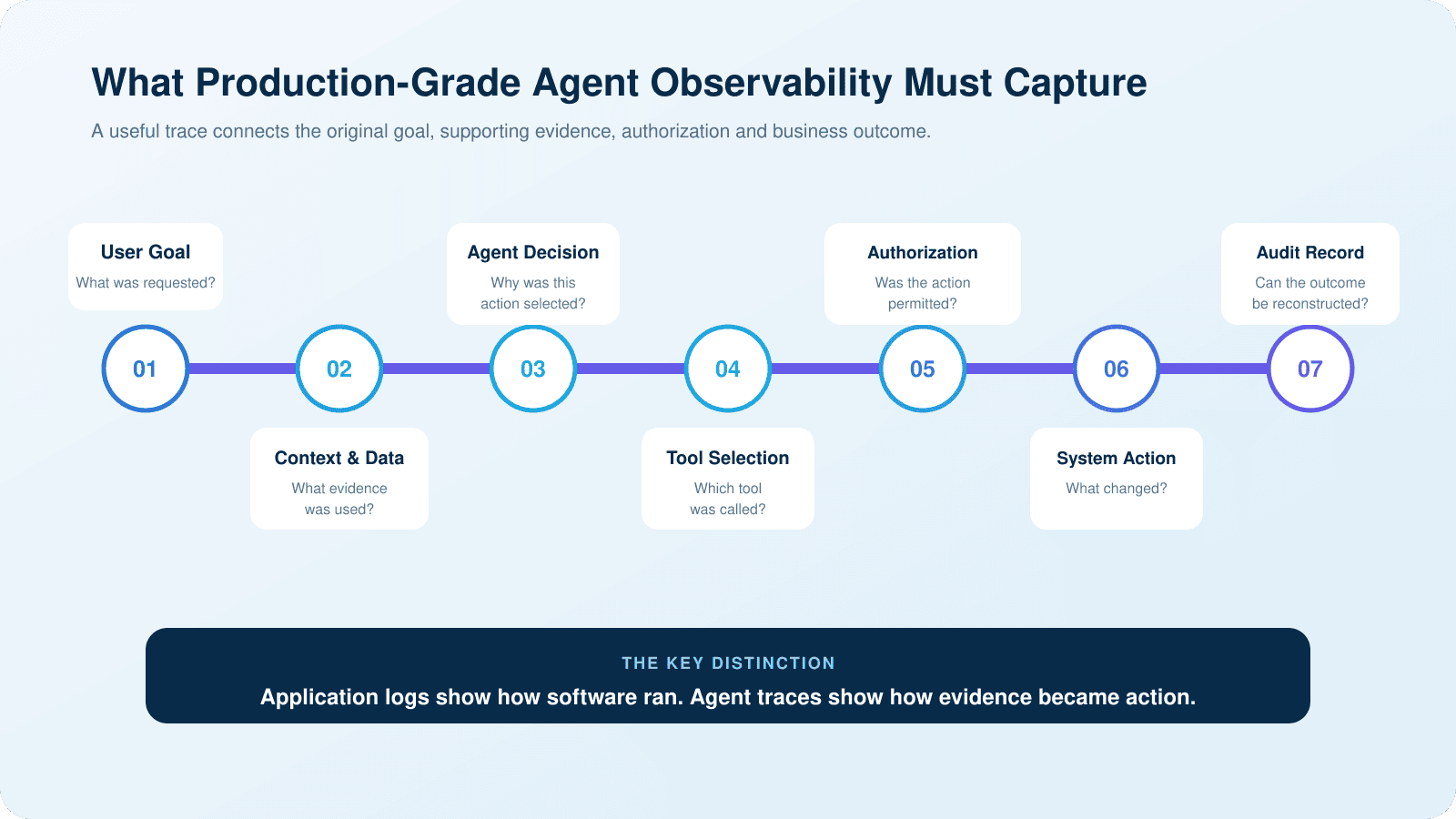
However, collecting more logs does not automatically create meaningful visibility. A useful agent trace should help teams reconstruct:
- The original goal assigned to the agent
- The context and data used to interpret that goal
- The plan or sequence of actions selected
- Every tool called and the result returned
- The authorization decision made before each action
- Any human approvals, exceptions or overrides
- The final effect on the business system
Application logs explain how software executed. Agent observability must go further by connecting evidence, decisions, authority and outcomes. Without that connection, teams may know that an API was called but still be unable to explain why the agent believed the call was appropriate.
Authority must be evaluated at the moment of action
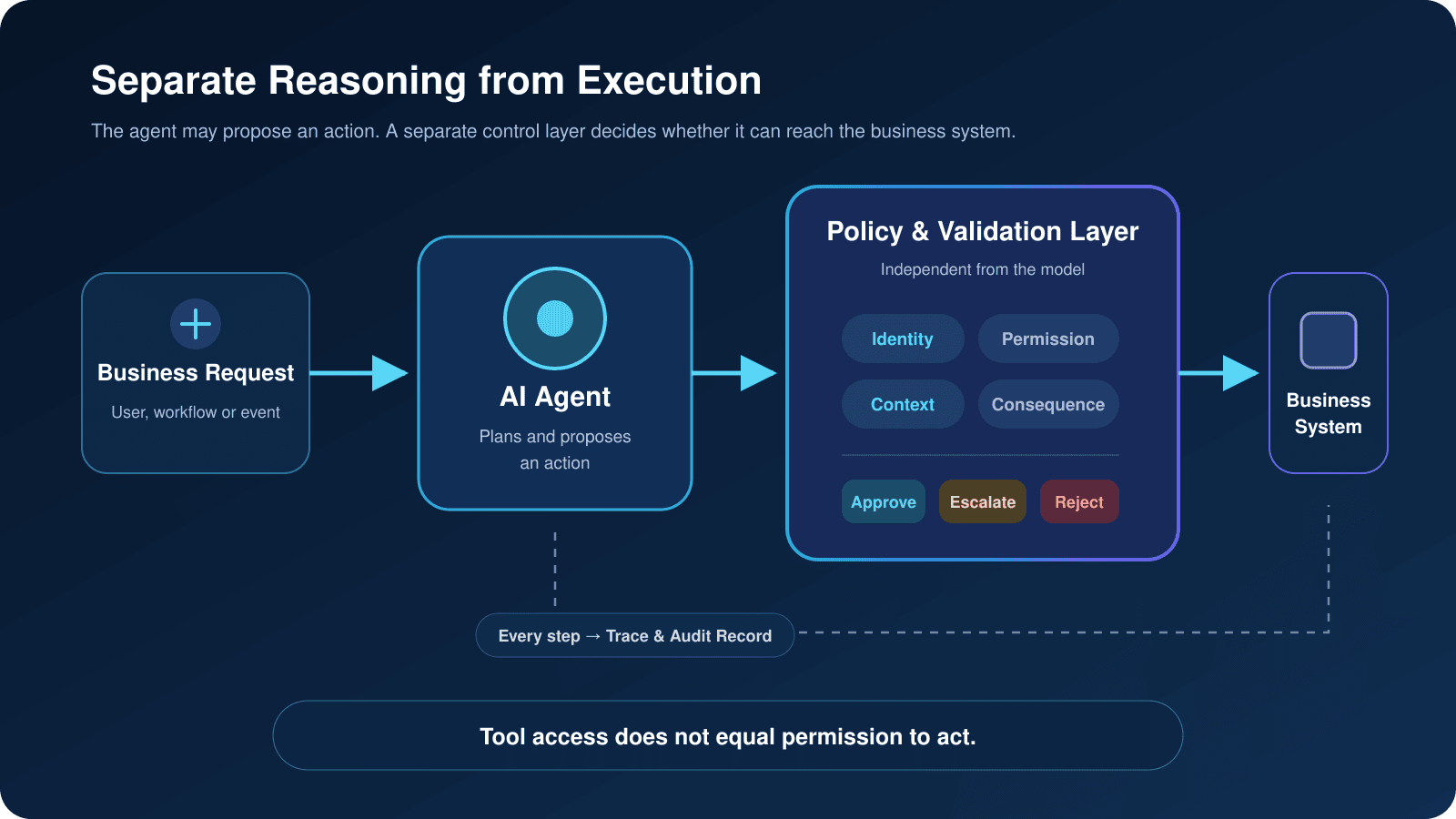
Giving an agent access to a tool is not the same as giving it permission to perform every operation that tool supports. Yet many early agent implementations blur that distinction by relying on broad service accounts or static credentials.
This creates a delegation problem. A user may be authorized to ask an agent for assistance, but that does not mean every downstream agent and tool should inherit the user’s full authority.
AWS highlighted this issue in its July 2026 security review, including guidance on maintaining least-privilege authorization across multi-agent delegation chains. The underlying principle is that permission should not expand simply because a task has passed through another agent.
Authorization therefore needs to be evaluated at the point where an action is about to occur. The system should consider:
- Who initiated the request
- Which agent is currently acting
- What data and tool are involved
- Which operation is being attempted
- The financial, legal or operational consequence
- Whether the current context satisfies the relevant policy
For example, a support agent might be permitted to prepare any refund request but execute refunds only below a defined threshold. A larger refund could require a named approver, while an unusual pattern of requests could suspend automated execution entirely.
This design is more robust than relying on the agent to decide when it should ask for help. The policy exists outside the model and remains enforceable even when the model misinterprets the situation.
Recovery is part of the product, not a fallback plan
Even well-governed agents will sometimes make poor decisions. Models are probabilistic, enterprise data can be inaccurate and external tools can fail midway through a workflow. Production architecture should therefore assume that some actions will need to be interrupted or corrected.
Recovery begins with preventing avoidable duplication. If an agent retries a failed transaction, an idempotency mechanism should ensure that the operation is not performed twice. For multi-step processes, the system may also need compensating transactions: explicit actions that reverse or offset work already completed.
High-impact workflows require further controls:
- Approval gates before irreversible actions
- Circuit breakers when behavior exceeds expected limits
- Timeouts for agents caught in repeated planning or tool-use loops
- Emergency stops and human overrides
- Versioned policies and prompts
- Complete audit trails from initial signal to final action
- A safe fallback when a model, data source or tool becomes unavailable
The Digital Twin System Framework, announced by the Digital Twin Consortium on August 25, 2026, provides a useful illustration for operational environments. It separates data, context, decision and process orchestration, and actuation. Before an AI-generated decision affects the physical world, the framework calls for clear authority, deterministic validation, auditability, emergency stops and human override.
The broader lesson applies beyond digital twins. Reasoning and execution should not be treated as the same layer. An agent may propose an action, but a separate control mechanism should determine whether that action is valid, authorized and safe to execute.
A practical production-readiness framework
Organizations do not need to begin with maximum autonomy. A more sustainable approach is to increase autonomy as evidence, controls and operational confidence improve.
Before an agent receives permission to act, product and engineering teams can evaluate it through three dimensions.
1. See it
Can the organization reconstruct the agent’s execution from the original request to the resulting system change? This requires more than infrastructure monitoring. Prompts, retrieved context, tool calls, authorization decisions and business outcomes need to be connected within the same trace.
2. Bound it
Is the agent’s authority limited by the user, task, data, tool, transaction value and operating context? Permissions should be specific, temporary where possible and verified again before consequential actions.
3. Reverse it
Can an incorrect action be stopped, corrected or compensated for without creating additional damage? If an operation cannot be reversed, the approval threshold and validation requirements should be correspondingly higher.
These dimensions should be considered part of the product’s acceptance criteria rather than a separate compliance exercise. A team may determine that an agent has achieved adequate task accuracy while still deciding that its observability or recovery mechanisms are not ready for unsupervised operation.
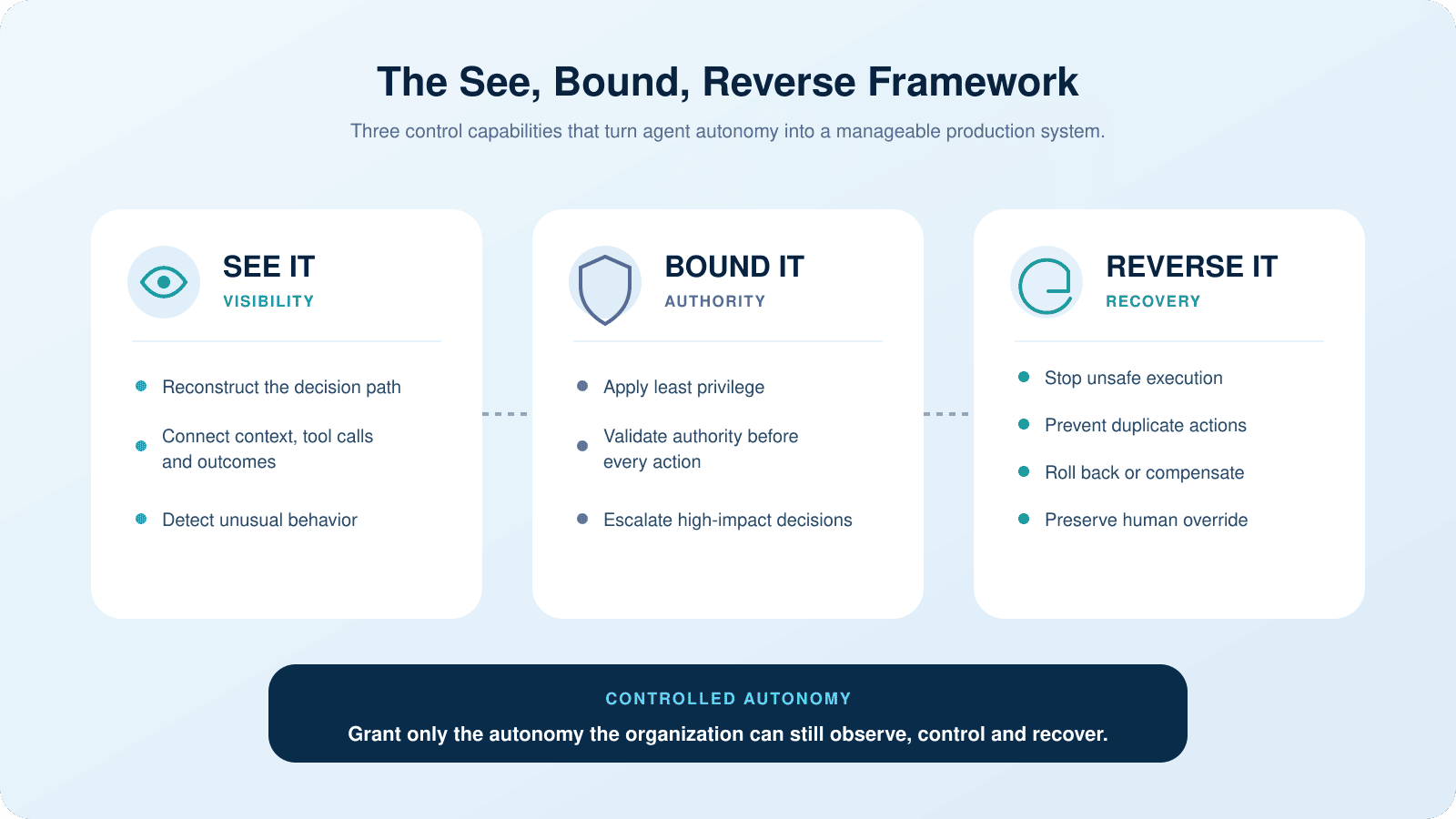
The objective is controlled autonomy
The strongest agent system is not necessarily the one that operates with the least human involvement. It is the one that applies the appropriate level of autonomy to each decision while preserving accountability.
For low-risk, reversible tasks, the agent may execute independently. For ambiguous or consequential decisions, it may prepare the work and request approval. When evidence is insufficient or system conditions move outside defined limits, it should be able to stop.
This creates a more useful definition of production readiness. An AI agent is ready not when it can complete a task once, but when the organization can repeatedly understand its decisions, enforce its boundaries and recover from its mistakes.
As AI agents become more capable, model intelligence will continue to matter. But the control layer around that intelligence will determine whether autonomy becomes a dependable business capability or simply a larger source of operational risk.