What the expanded NVIDIA–MediaTek partnership reveals about custom silicon, local AI and the future of edge-to-cloud architecture
On August 31, 2026, NVIDIA and MediaTek announced an expansion of their long-standing collaboration across three computing environments: rack-scale AI infrastructure, local AI systems and software-defined vehicles. MediaTek will adopt NVIDIA’s NVLink Fusion platform for custom AI processors, while the companies will continue developing chips for personal AI computers and automotive platforms.
NVIDIA also invested $3.5 billion in convertible bonds issued by MediaTek. Although the financial commitment makes the partnership significant, its broader importance lies in the architecture the two companies are building. AI computing is no longer developing as a collection of separate markets for data centers, personal devices and vehicles. These environments are beginning to form a connected computing continuum in which different parts of an AI workload can run in different locations.
Edge-to-cloud does not mean running the same AI everywhere
The phrase “edge-to-cloud” can imply that a single AI system simply moves between a device and a data center. In practice, the architecture is more deliberate. Different parts of a workload belong in different environments.
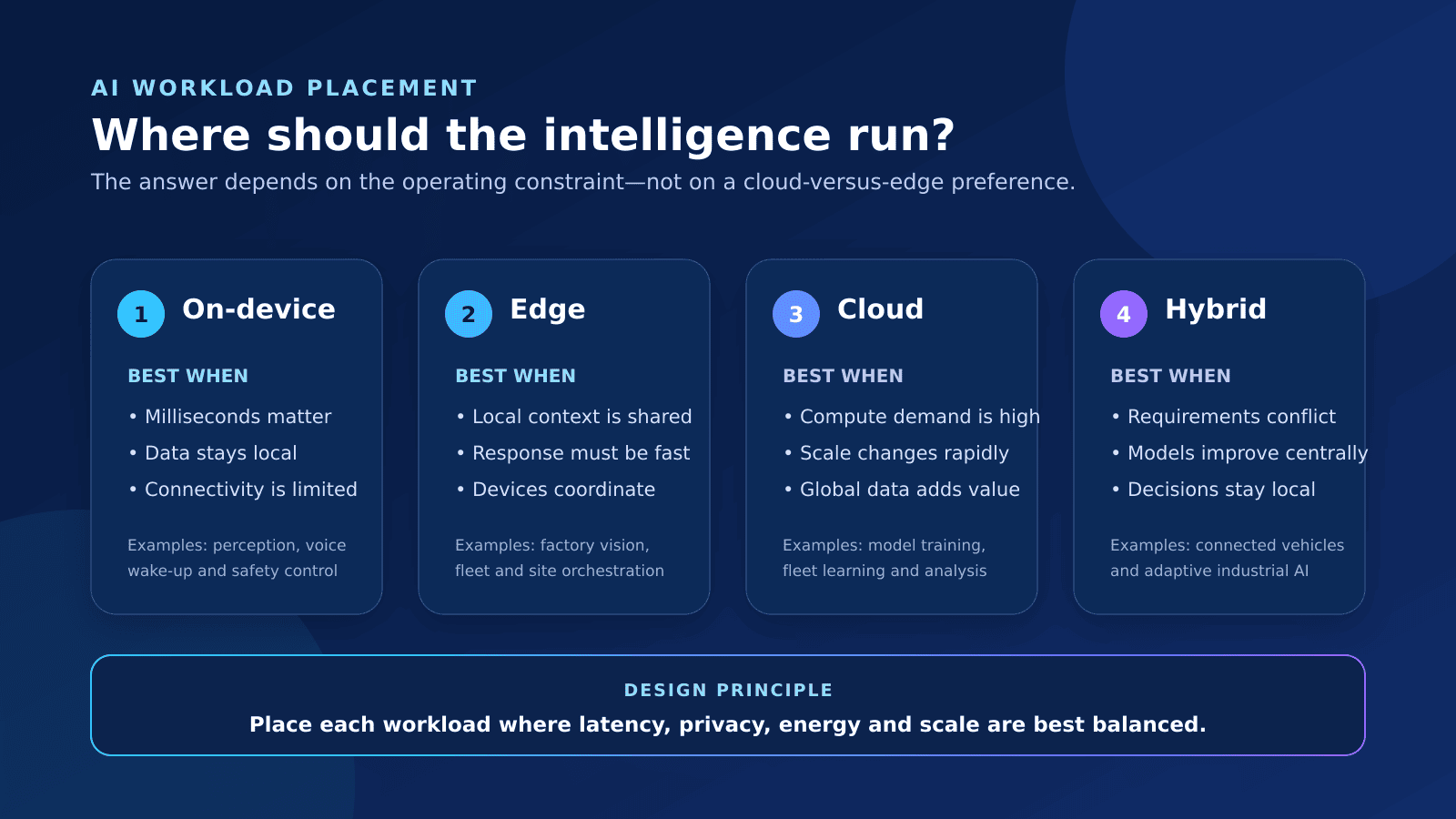
A large model may require the capacity of a cloud AI factory for training, complex reasoning or processing extensive organizational data. A laptop or workstation may handle private information locally, provide an immediate response or continue operating without a stable network connection. A vehicle may need to interpret sensor data and respond within milliseconds, making a round trip to the cloud unsuitable for safety-critical decisions.
The architectural question is therefore not whether edge AI will replace cloud AI. It is how an application should divide its work according to latency, privacy, energy consumption, connectivity, cost and computational scale.
The NVIDIA–MediaTek collaboration spans these layers. Its AI infrastructure work focuses on custom accelerators for rack-scale systems. Its local-computing work brings accelerated AI into PCs and developer systems. Its automotive work combines energy-efficient system-on-chip design with graphics, AI and software platforms for increasingly intelligent vehicles.
The strategic value comes from connecting these layers without assuming that they perform identical roles.
Custom silicon is becoming a system-design problem
MediaTek will join NVIDIA’s NVLink Fusion ecosystem to help hyperscalers, cloud providers and model developers create custom XPUs that can connect with NVIDIA’s rack-scale infrastructure.
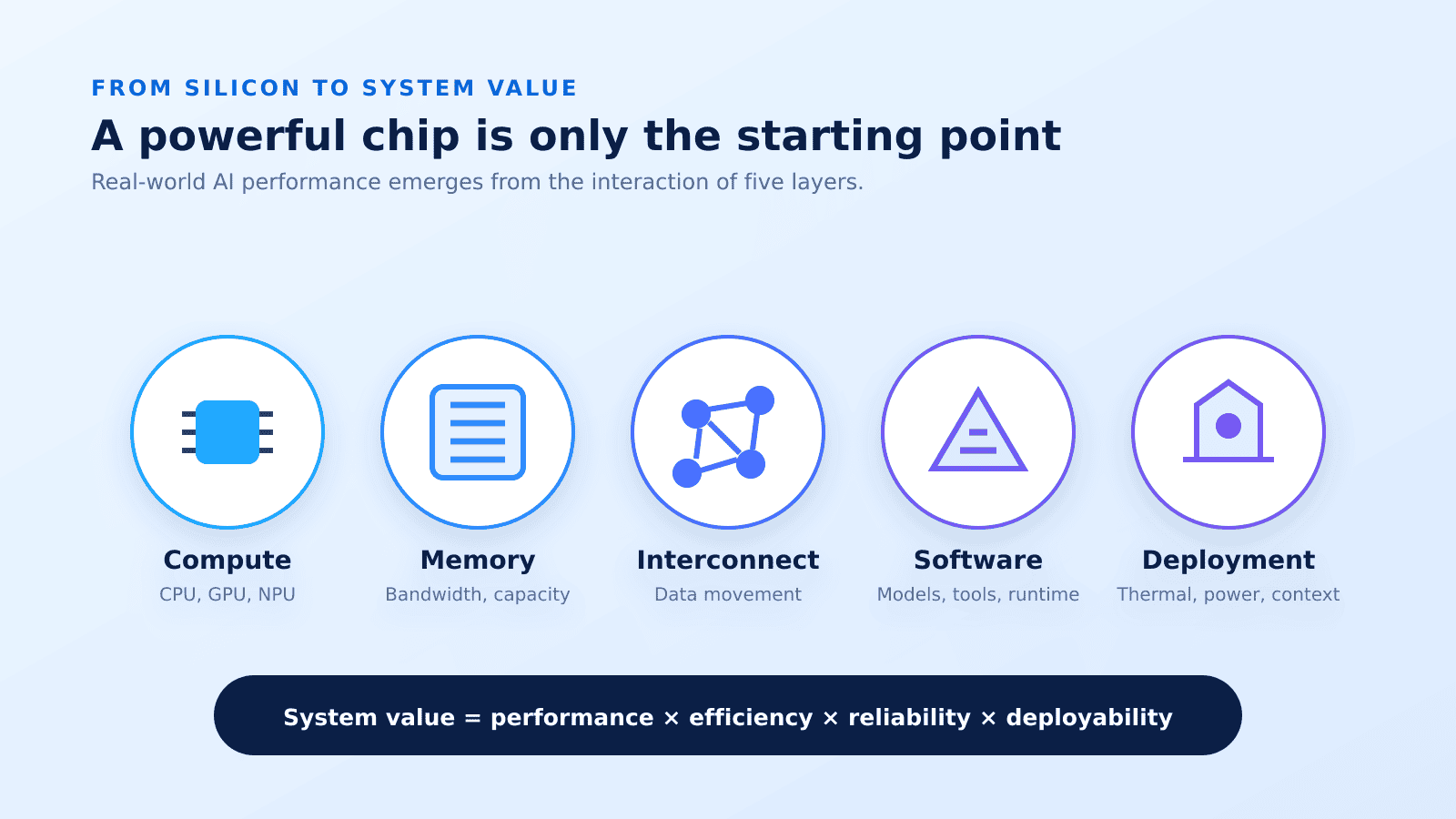
Organizations are increasingly interested in custom processors because specialized workloads may benefit from hardware designed around particular performance, cost or energy requirements. But designing the compute engine is only one part of delivering an operational AI system.
A production-ready accelerator must also work with high-bandwidth memory, interconnects, advanced packaging, networking, power, cooling and manufacturing processes. At rack scale, weaknesses in any of these elements can limit the performance of the entire system.
NVLink Fusion is intended to provide a prevalidated foundation around the custom processor. According to the companies, the platform incorporates technologies for chip-to-chip communication, memory integration and connection to the wider NVLink fabric. MediaTek can then help customers adapt connectivity, packaging, memory, performance and power characteristics to their workloads.
This arrangement illustrates a broader shift in semiconductor strategy. Differentiation is moving beyond the design of an individual chip. It increasingly depends on whether that chip can become part of a qualified, manufacturable and scalable system.
For enterprise technology leaders, this distinction is important. A benchmark measured at the processor level may say little about the cost and difficulty of deploying the complete infrastructure in production. System integration, software compatibility and operational efficiency can matter as much as theoretical compute performance.
Local AI changes the economics and experience of applications
NVIDIA and MediaTek previously collaborated on the GB10 Grace Blackwell Superchip used in DGX Spark. Their expanded relationship includes future generations of DGX Spark and RTX Spark chips intended for consumer computers, AI developer systems and enterprise workstations.
Local AI should not be understood merely as a smaller version of cloud inference. It creates different product possibilities.
Applications can process sensitive information without transferring every input to an external service. They can respond with lower latency, remain useful when connectivity is limited and reduce repeated cloud-inference costs for frequent tasks. Developers can also test, customize and operate certain models closer to where data is created.
These advantages come with trade-offs. Local systems have tighter memory, power and thermal limits. Models may need to be compressed, routed or divided across local and cloud resources. Enterprises must also manage model versions, security policies and monitoring across a distributed fleet of devices rather than within a centralized environment.
The resulting application architecture may combine several execution paths. A local model can handle immediate or privacy-sensitive work, while a larger cloud model manages tasks requiring greater context or computational capacity. The product must decide which path to use and communicate those boundaries clearly to the user.
This makes workload orchestration a product-design issue, not merely an infrastructure concern.
The vehicle makes the edge requirement impossible to ignore
The third area of collaboration covers software-defined and AI-powered vehicles. MediaTek’s Dimensity Auto platforms integrate NVIDIA technologies for intelligent cockpits and can operate alongside NVIDIA DRIVE AGX.
Vehicles demonstrate why the edge-to-cloud model needs clear boundaries. Entertainment, navigation updates and fleet analytics may benefit from cloud connectivity, while perception and immediate driving responses must occur locally. A loss of connectivity cannot be allowed to remove essential capabilities.
Automotive systems also operate under long product lifecycles, strict thermal and power constraints, and more demanding safety requirements than ordinary consumer applications. Hardware and software therefore need to evolve together without weakening the validated boundaries of the system.
The larger implication extends beyond automotive. Robots, industrial equipment, medical devices and smart infrastructure face similar constraints. When AI interacts with the physical world, the placement of computation becomes part of the product’s reliability and safety model.
A shared stack can reduce complexity, but not eliminate it
By combining NVIDIA’s accelerated computing and software ecosystem with MediaTek’s expertise in energy-efficient systems-on-chip, connectivity and custom silicon, the companies aim to provide common foundations across multiple computing environments.
That does not mean every layer will become interchangeable. A model optimized for a rack-scale AI factory will not automatically perform effectively within the power envelope of a laptop or vehicle. Nor will shared hardware interfaces remove the need for workload-specific testing, governance and security.
The potential advantage is architectural continuity. Developers may be able to use more consistent tools, model formats and software components as workloads move from large infrastructure to local systems. Hardware teams can build differentiated processors without independently recreating every surrounding technology required for deployment.
However, the announcement describes a multigenerational collaboration whose implementation and commercial outcomes remain subject to development and market risks. Businesses should treat it as a direction of travel rather than evidence that a fully unified edge-to-cloud platform is already available.
The next AI architecture begins with placement
For organizations building AI-enabled products, the most useful lesson is not that every system now requires custom silicon. It is that computing placement should become an explicit architectural decision.
Teams need to identify which operations require immediate local execution, which data should remain within a controlled environment and which workloads genuinely benefit from cloud-scale resources. They must also determine what happens when a connection fails, when the local model lacks sufficient capability or when an action crosses an operational or safety boundary.
The NVIDIA–MediaTek partnership reflects a future in which AI is distributed across data centers, personal computers, vehicles and other edge systems. The strongest products will not simply connect all these environments. They will assign each decision to the environment best equipped to handle its latency, privacy, energy and accountability requirements.
Edge-to-cloud AI is therefore less about making intelligence available everywhere than about deciding where each form of intelligence should operate.