A detailed 3D factory can look convincing and still answer the wrong engineering question. A production manager may need queue and throughput evidence, a robotics engineer may need reach and path feasibility, and a safety specialist may need independently validated load dynamics. Manufacturing simulation should therefore be selected by the decision, required inputs and evidence standard, not visual complexity. This guide is a method-selection overview; software vendor comparisons belong in the separate Manufacturing Simulation Software guide.
Manufacturing simulation is most effective when the model follows the engineering question. Before selecting software or building a highly detailed 3D factory, teams should determine which behavior matters, which measurements will answer the question and what validation evidence they need.
What Is Manufacturing Simulation Used For?
Manufacturing simulation uses computational models to represent selected behavior of a production system. Different approaches can examine event timing and queues, robot motion, physical interactions or longer-term feedback effects. Every model simplifies reality; it should be judged by fitness for its intended decision, not the number of objects in the scene.
A plant manager might need a capacity estimate. A controls engineer may want to examine sequencing logic. A robotics engineer may need to check whether proposed movements are geometrically possible. A specialist evaluating moving loads may need physics-based evidence. These related questions do not require the same type of model.
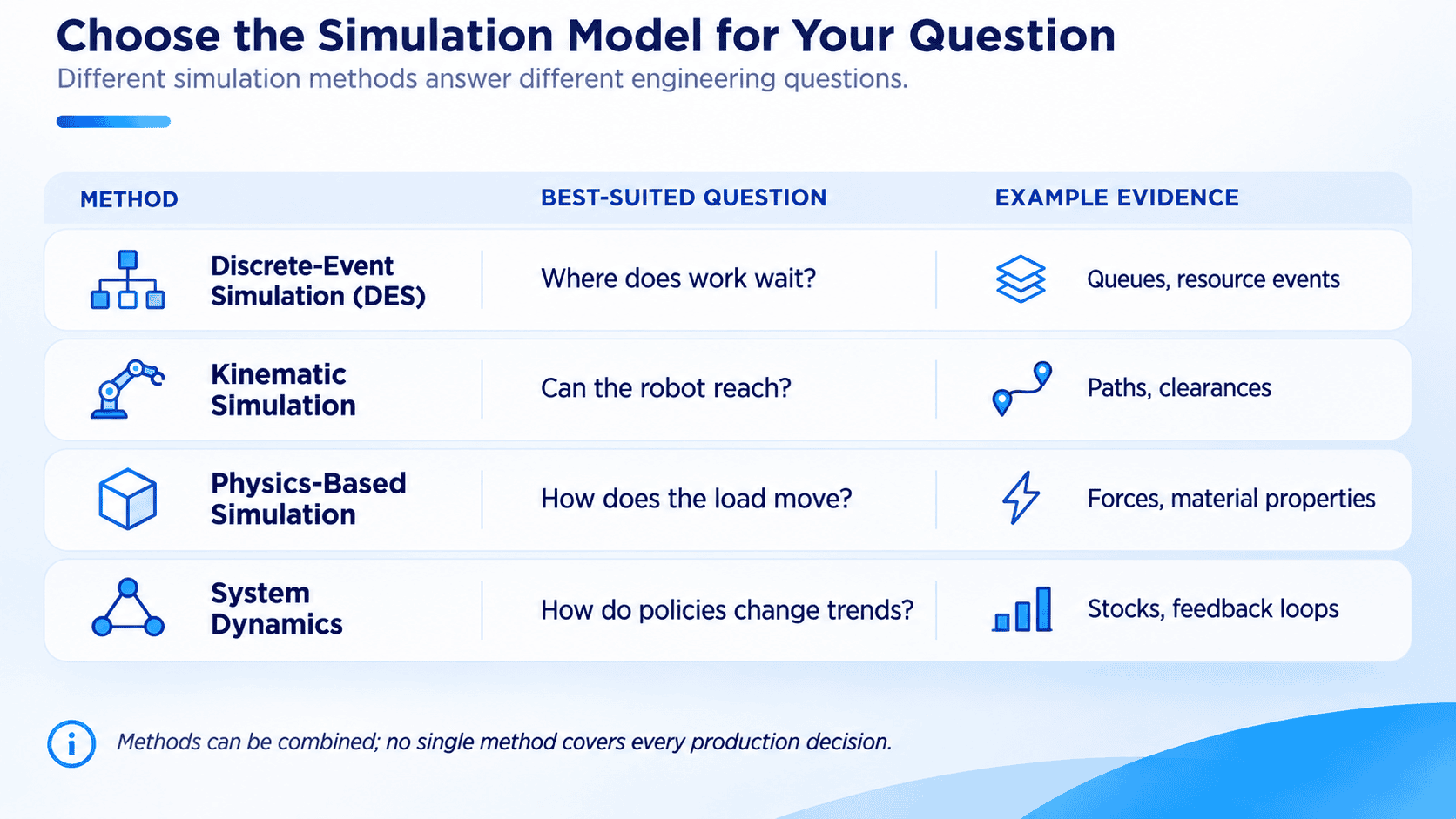
Four Modeling Approaches and Their Best Questions
Discrete-event simulation: How does work move through queues?
Discrete-event simulation describes events such as part arrival, machine start, completion, failure and transfer. It supports analysis of waiting, blocking, resource states, WIP and output under different operating policies. NIST's SimPROCESD, which models multistage production with finite buffers and maintenance behavior, illustrates this approach.
Kinematic simulation: Can equipment follow its planned motion?
Robot and mechanism models can examine paths, reachability, cycle sequences and geometric interference. Such a result can inform engineering checks, but should not be presented as a certified safety result or a whole-factory throughput forecast without further analysis.
Physics-based simulation: How does a moving load behave?
Where the question involves inertia, load stability or dynamic contact, the model may require mass, geometry, center of gravity, friction and operating conditions. Calibration and validation are essential. A visual forklift demonstration is not the same as manufacturer-approved load-capacity guidance.
System dynamics: How might policies affect longer-term behavior?
System-dynamics models represent accumulations, flows and feedback over broader time scales. They can help explore questions about capacity investment, staffing or demand-response policies. They are not substitutes for detailed event models when the decision depends on the exact order in which parts enter stations.
How to Choose the Right Simulation Scope
Start with a testable decision
“Optimize the factory” is too broad to verify. A useful study asks whether one scheduling rule reduces late orders, or whether a proposed robot can reach all required positions. This clarifies what the model must represent and what it can leave out.
Define performance outputs before visuals
A capacity study needs completed good units, queues, flow time and utilization. A motion study needs paths, reach and interference checks. A physical-load study needs relevant forces and validated material parameters. Detailed imagery is helpful only when it supports the required evidence.
Model the smallest relevant system boundary
Include resources and dependencies that materially influence the question. A packaging-line analysis may need upstream arrival patterns and a downstream shipping constraint but not every machine in the facility. State which interactions have been excluded.
Make a validation plan
Separate measured inputs from engineering assumptions. For an existing system, check whether the baseline reproduces relevant observations. For a proposed facility, compare the model to specifications and independently verified behavior. Different simulation types require different acceptance checks.
One Proposed Factory Change, Three Different Studies
Imagine a plant considering a robot-assisted transfer between production cells. The production manager wants to know whether good units per shift will increase. The robotics engineer wants to verify reach and clearance. The safety specialist needs evidence about a moving load under specified conditions.
A single 3D scene can illustrate all three, but a defensible study may combine discrete-event flow modeling, kinematic assessment and a physics-based model where appropriate. Their assumptions and interfaces must be documented. Outputs from one model should not be used as proof of a different kind of performance.
Which Data Should a Manufacturing Simulation Project Prepare?
Depending on the scope, inputs can include process maps, routing and dispatch rules, cycle-time distributions, resource calendars, buffers, product mix and arrivals, CAD geometry, motion limits, and maintenance or failure records. Data owners should record units, timestamps, missing observations and uncertainty.
NIST's production-systems requirements work documents the importance of defining simulation input information before implementation. Where inputs are unavailable, assumptions may support early exploration, but they should be labeled rather than silently treated as measured data.
Is Manufacturing Simulation the Same as a Digital Twin?
A simulation can run offline and compare future scenarios using defined assumptions. An operational digital twin additionally maintains a relevant data relationship with the physical asset or process. The value of continuous connectivity depends on decision needs, data quality and the cost of operating the integration.
A focused offline model may be the right first step when a factory still needs to identify its most important constraints. Live data connections can be assessed later if they create operational value.
A Method-Selection Matrix for a Real Procurement Brief
Consider a hypothetical manufacturer proposing a robotic transfer cell. The same project creates three questions: will good units per shift increase, can the robot reach all required positions, and will a moving load remain stable under specified conditions? A discrete-event model can evaluate arrivals, queues and shared resource demand. A kinematic model can check path and reach. A physics-based assessment can examine forces and load motion when the assumptions and safety review warrant it.
Demand evidence suited to the method
For an event model, request time-stamped flow observations, station calendars and repeated scenario statistics. For a motion model, request CAD revisions, coordinate frames, joint limits, path checks and relevant controller assumptions. For a physics model, request mass properties, contact and friction assumptions, solver settings, boundary conditions and a validation approach. A cinematic 3D scene is not a substitute for any of these data sets.
Keep model interfaces explicit
If the event model assumes a robot transfer takes six seconds, an engineer should be able to trace that value to measurement, specification or a kinematic model. If a dynamics model changes the permitted motion, update the event model's cycle-time assumption and rerun the capacity analysis. This coupling must be documented; results cannot be declared consistent merely because they appear in one visualization.
The decision-ready deliverable is a scope matrix: question, appropriate method, input owner, outputs, validation test and exclusions. It should also explain when no simulation is justified—for example, where a basic process map and a verified calculation already answer the question.
What Should a Decision-Ready Study Deliver?
A decision-ready simulation deliverable contains a short method-selection matrix with six fields: engineering question, chosen model type, input-data owner, decision KPI, validation test and exclusions. For example, a capacity question needs a documented event model and repeatable throughput results; a robot-reach question needs geometry, joint limits and a motion check. Combine methods only when their outputs and assumptions can be traced across models. Avoid commissioning a complex model when a verified calculation already answers the decision.
For a manufacturing simulation scoping discussion, bring one decision, an overview of available process and CAD data, and the evidence needed for approval. BlueOC's Manufacturing Solutions and Digital Twins capabilities can help clarify which model types are necessary and which are not.