A production line does not change continuously in one smooth motion. A part arrives, a machine starts, a buffer fills, and a completed unit moves to the next operation. Discrete-event simulation in manufacturing represents these changes as events, allowing teams to study waiting, resource conflicts and system output over time.
This method is particularly useful when the decision depends on the order and timing of operations, not just the rated speed of equipment. It can help manufacturers examine proposed layout changes, capacity additions and handling rules before physical implementation.
What Is Discrete-Event Simulation?
Discrete-event simulation, often shortened to DES, is a modeling approach in which the system changes state when a defined event occurs. Between events, the relevant simulated state can remain unchanged. A simulation clock advances as the model processes arrivals, starts, completions, failures and releases.
A DES model might represent machines as resources, boxes as entities, conveyors as transfers and buffers as queues. Logic determines when a resource can start work and where completed material moves next.
How an Event Changes a Production System
Part arrival: Update work waiting for processing
An incoming item may enter a buffer. If the next machine is available and the routing conditions allow it, processing begins. Otherwise the item waits and the queue length increases.
Machine start: Reserve the required resource
The system changes when a machine or operator begins a task. The model records a start time and schedules a future completion according to a processing-time assumption.
Completion and transfer: Release or block the output
Once a task finishes, the item may transfer downstream. If the next buffer is full, the current station may be blocked. If material is unavailable, a downstream station may be starved.
Equipment failure: Change resource availability
A machine may become unavailable until repair. Repair time, maintenance policy and the timing of failures can materially change throughput and queue behavior, especially for shared critical resources.
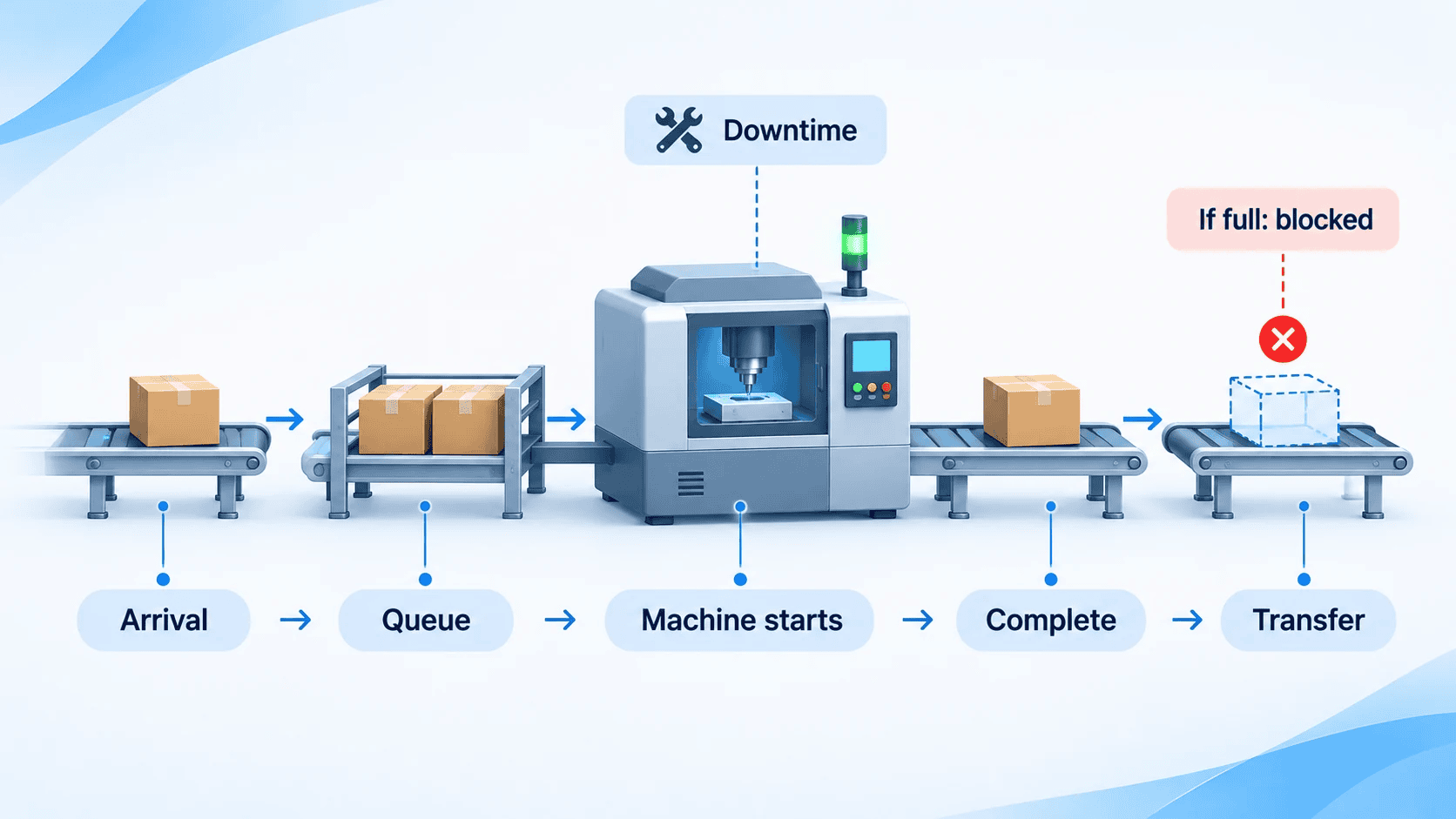
Figure 1. Conceptual discrete-event sequence: material arrival, resource start, processing completion and release. This diagram explains model logic; it is not a screenshot of BlueOC's simulation software.
Which Inputs Does a Manufacturing DES Model Need?
Inputs depend on the decision. A layout and capacity model might include arrival schedules, processing-time distributions, routing rules, buffer capacities, resource availability, product mix and equipment downtime. More detail is not always better; every extra assumption should help answer the decision question.
Teams should distinguish observed data from engineering estimates. A model can produce precise-looking outputs from weak inputs. Validate the baseline against real production behavior where feasible, and document uncertainties when planning a new facility.
What Outputs Can DES Produce?
Typical outputs include completed units per period, utilization, waiting and blocking time, queue lengths, work in progress and total flow time. These measures provide a system-level view of how changes in one resource affect others.
NIST's SimPROCESD is a discrete-event simulation package for asynchronous production lines with finite buffers and maintenance behavior. Its documented purpose illustrates how state-based models can help investigate production interactions.
DES Compared With 3D Factory Visualization
A 3D animation can make a model easier to understand but does not establish its underlying simulation methodology. DES focuses on the event sequence, resource constraints and performance measures. It can be displayed as tables, charts, 2D diagrams or 3D animation.
BlueOC's Industrial Simulation – Manufacturing Applications video shows visual line configurations with throughput, average box delay and robot-state indicators. The footage alone is not enough to confirm whether its internal engine implements DES, another simulation approach or a combination. It should therefore be treated as an illustration of the questions such models can help investigate, not proof of a specific software architecture.
A Practical DES Project Workflow
Define a single operational question
Examples include whether an additional line improves finished output, which shared resource creates waiting or whether a buffer change reduces blocking. Set the production boundary and decision metric before building the model.
Build and validate the reference scenario
Translate the operating process into entities, activities, queues and resource rules. Check that modeled material flow resembles observed behavior in the relevant situations.
Test alternatives with consistent assumptions
Keep product mix, shift duration and demand assumptions aligned unless those inputs are the deliberate variables being studied. Repeat stochastic runs; inspect variability rather than selecting only a favorable outcome.
Report trade-offs and limitations
A good result explains the proposed change, the observed range of effects, the assumptions that drive it and the evidence still required. A capacity increase that raises inventory and handling cost may not be the best investment.
A Small Event Trace: Why Queue Time Appears
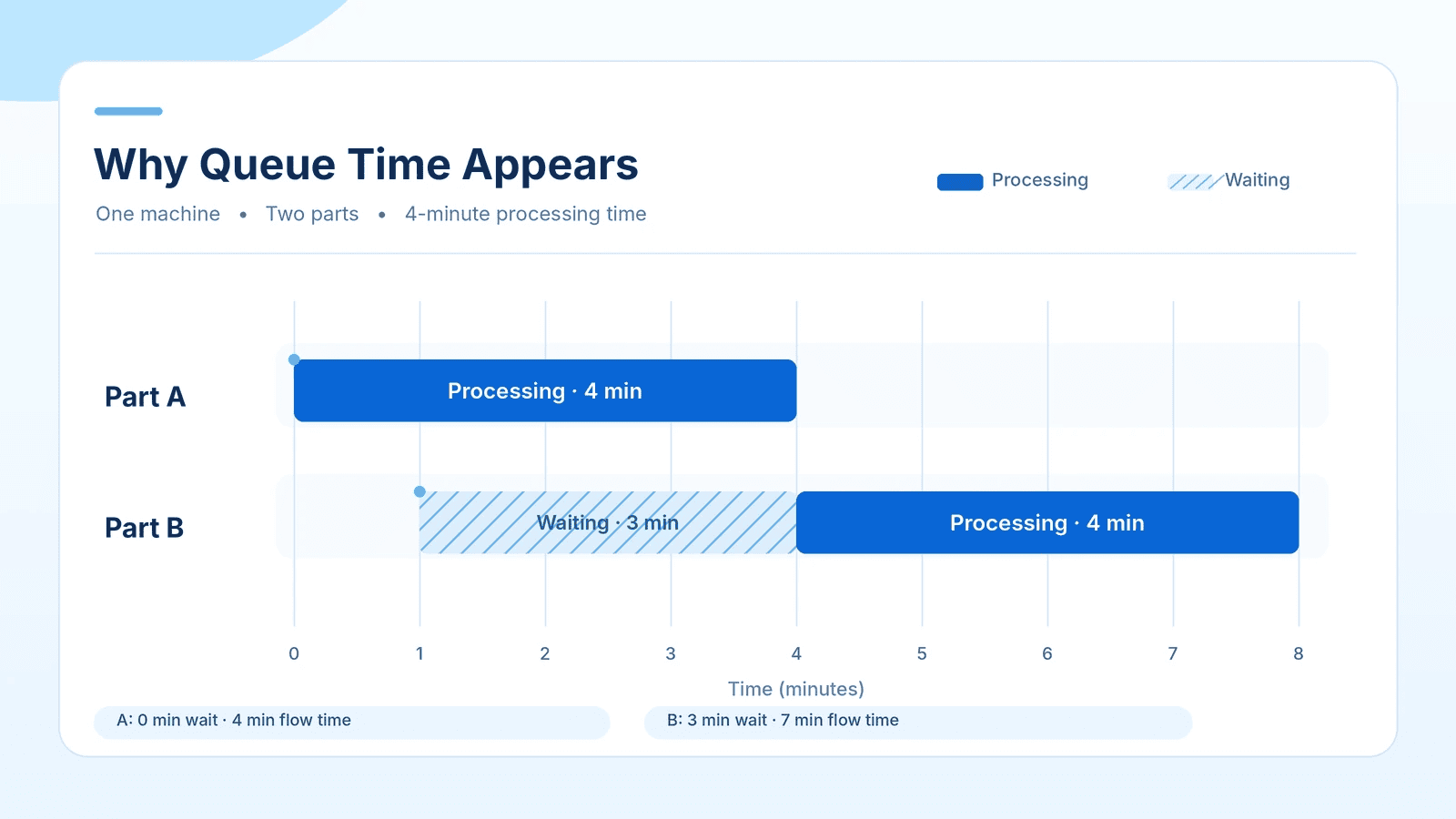
Consider a deliberately simplified, deterministic model with one machine, one waiting place and a four-minute processing time per part. Part A arrives at minute 0 and starts immediately. Part B arrives at minute 1, but A occupies the resource until minute 4. B then starts at minute 4 and finishes at minute 8. The model does not need an animated conveyor to establish this queue: the start and completion events define it.
Calculate the individual outcomes
A has zero waiting and a four-minute flow time. B waits three minutes, then processes for four, so its flow time is seven minutes. During the interval from minute 0 to minute 8, the machine is continuously processing; that alone does not say the system can meet demand once arrivals or downtime change. Adding another part at minute 2 would alter the event list and waiting state, not merely the picture on the screen.
What a credible simulation output should let you inspect
For each entity, keep arrival, queue-entry, processing-start, completion and exit events. For each resource, log idle, busy, blocked and unavailable intervals where those states exist. Verify event ordering, the conservation of parts and what happens when the buffer fills. Once processing times and arrivals are randomized, use repeated runs and confidence intervals instead of presenting the deterministic example as a capacity forecast.
NIST's SimPROCESD documents discrete manufacturing objects for sources, processors, buffers and probes. An implementation may differ, but the discipline of making state transitions observable is what distinguishes an analyzable event model from an unexplained animation.
Use DES Where Timing and Dependencies Matter
Discrete-event simulation turns manufacturing decisions into structured experiments. Its value comes from representing the dependencies among material, queues and resources, then comparing alternatives with verified inputs and clear metrics.
For a DES discovery discussion, define one queueing problem and assemble arrival, service and downtime timestamps from the same process boundary. BlueOC's Manufacturing Solutions and Digital Twins capabilities can help evaluate whether event-based modeling fits that problem.