
A factory can be recreated in remarkable detail. Machines occupy their exact positions, production lines move across the screen, and dashboards display the latest operating conditions. Yet when a production manager asks whether a new product can run on the existing line, the team may still need days of manual investigation to answer.
That gap deserves attention. A digital twin becomes valuable when its representation of the physical world helps someone evaluate a choice, understand the consequences and act with greater confidence. For the people funding, building and using these systems, the most useful starting point is the decision they need to improve.
Begin with a decision that matters
“Build a digital twin of the factory” describes an ambition, but leaves the practical scope unresolved. A more useful brief identifies a decision: whether a vehicle can move through an existing production line without collision, which equipment configuration can accommodate a new product, or when a maintenance intervention would cause the least disruption.
Each question requires different evidence. A collision check depends on geometry, clearances and movement. A production scheduling decision depends on capacity, processing times, dependencies and variability. A maintenance decision may require equipment condition, failure history and the availability of people and spare parts.
The Digital Twin Consortium’s definition reflects this relationship between purpose and implementation. It describes a digital twin as a data-driven representation synchronized with its real-world counterpart at a specified frequency and fidelity, and explicitly connects digital twins to use cases and outcomes. This allows the required detail and update frequency to be determined by the application.
For a product team, this suggests a practical starting document: name the decision, identify its owner, describe the available alternatives and define what a better outcome would look like. A twin with a clear decision owner has someone who can judge whether its output is useful and take responsibility for acting on it.
What BMW’s virtual factory makes concrete
BMW provides a useful example of this approach. In June 2025, the company described using its Virtual Factory to check whether new vehicle models could move through existing production lines without colliding with their surroundings. The process combines construction data with 3D scans and simulates the vehicle’s movement and rotation.
According to BMW, these checks could be simulated in three days, compared with almost four weeks of physical testing previously. The company also projected that its broader Virtual Factory initiative could reduce production planning costs by up to 30%; that figure was a projection, rather than a reported saving already achieved.
The useful lesson is how precisely the application connects to a decision. Planners need evidence that a product will fit through a line before committing to its introduction. The simulation provides that evidence earlier, allowing teams to identify problems while changes are still easier to make.
This is a strong pattern for selecting an initial use case: find a consequential question that is currently expensive, slow or disruptive to answer, then determine whether a validated virtual model can improve that process.
Model the constraints that could change the answer
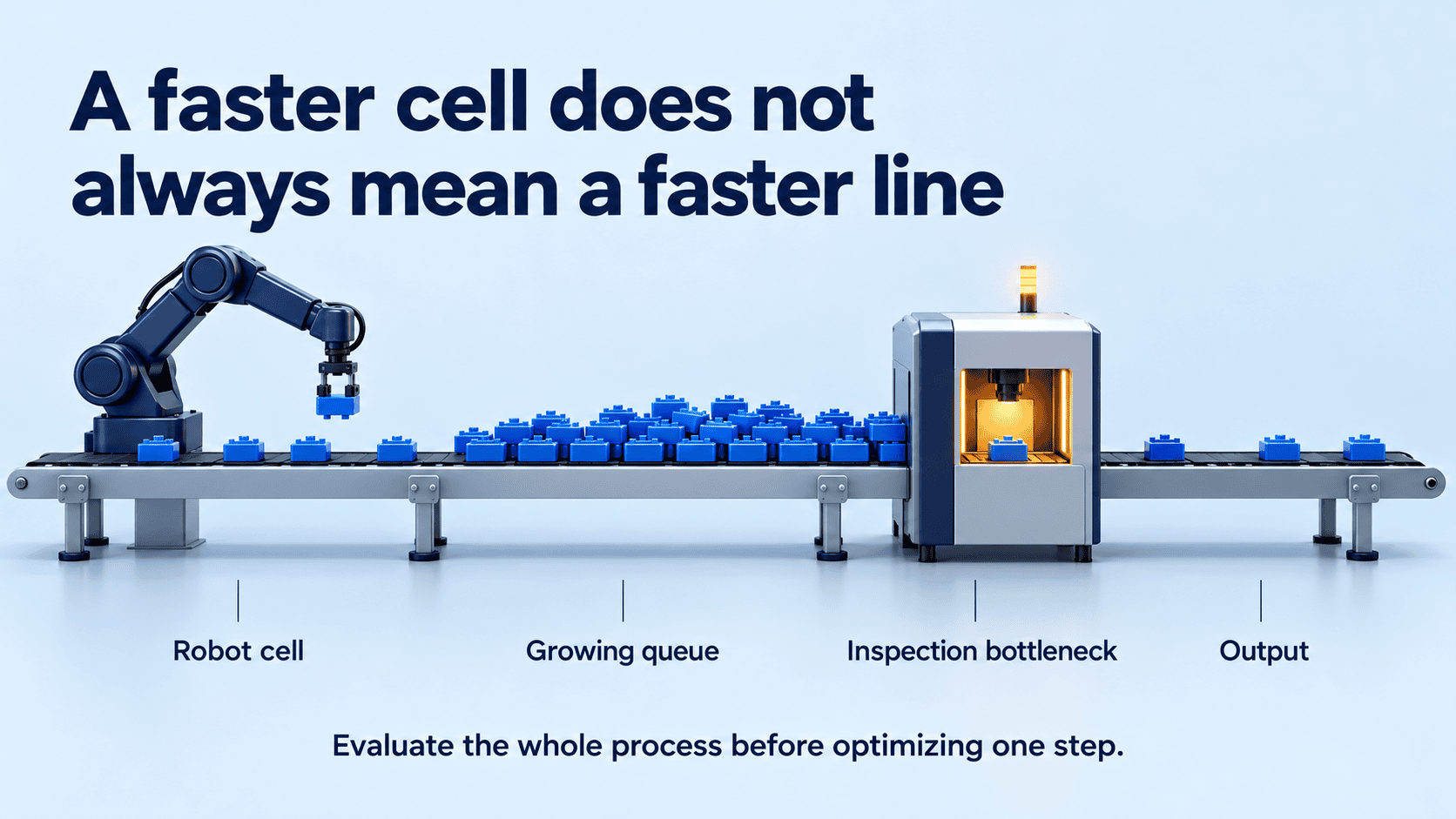
Consider a hypothetical manufacturer evaluating a robotic assembly cell. The engineering team wants to increase output by changing the robot’s movement sequence. A simulation shows a shorter cycle, and the proposed configuration appears promising.
However, the downstream inspection station already limits production. The faster robot could simply increase the queue before inspection. The local improvement would be real, while the factory’s output remained unchanged.
This illustrates why domain knowledge matters when defining the model’s boundaries. The twin needs to represent enough of the surrounding process to reveal whether an apparent improvement survives contact with the wider system. Depending on the decision, that may include buffers, operator availability, changeovers, material arrival patterns or maintenance access.
A useful scoping exercise connects each decision to the information that could alter it:
The objective is to make the model sufficiently complete for the decision. Additional detail earns its place when it changes the recommendation, exposes a meaningful risk or increases confidence in the result.
Match accuracy and freshness to the decision
A detailed model can create an impression of certainty. For operational use, teams need to establish where that certainty is justified.
Two requirements deserve separate consideration. Fidelity concerns how accurately the model represents the relevant behaviour. Freshness concerns whether its information still reflects the conditions in which a decision will be made.
A layout assessment may depend heavily on accurate dimensions and the latest equipment configuration. A short-term dispatching decision may depend on rapidly changing machine availability. These applications require different update strategies, even when they concern the same facility.
Validation should therefore be tied to the intended use. Teams should compare predicted results with physical observations, examine conditions where the model performs poorly and agree on acceptable error before relying on its recommendations. A model calibrated against normal operation should also be challenged with plausible variations, such as a different product mix, interrupted material supply or equipment degradation.
The decision interface should make these limits visible. Users need to know which configuration was tested, when the underlying information was updated and which assumptions shaped the result. When conditions move outside the validated range, the system should flag the need for review. That gives engineers a reason to trust the output within its boundaries.
Make the recommendation usable in the real workflow
A technically sound simulation can still arrive too late to influence a decision. If the production plan has already been approved or equipment has already been ordered, the opportunity to act may have narrowed considerably.
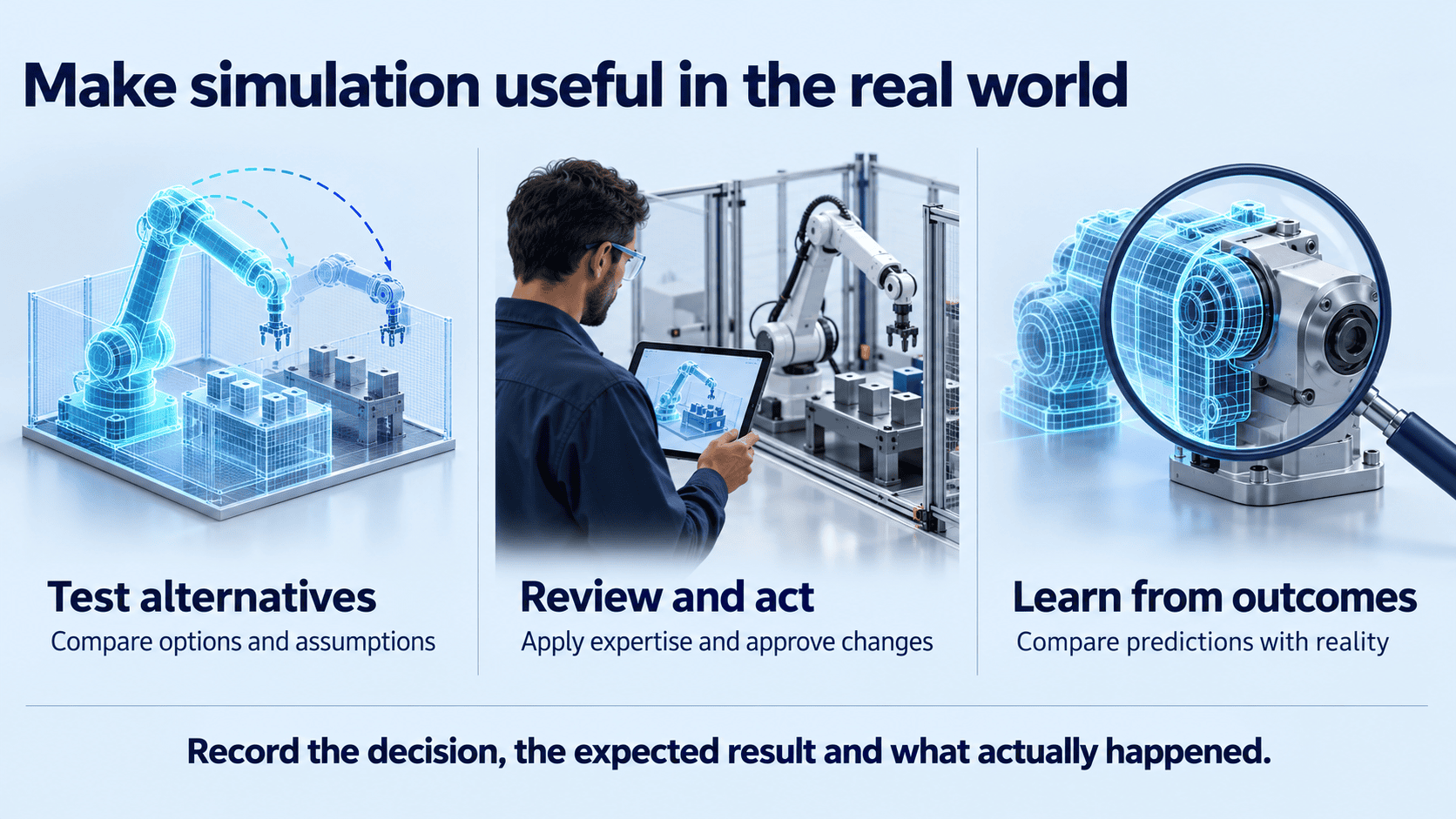
This makes workflow design part of the digital twin’s value. The team needs to define when a simulation is requested, who evaluates the result and how an approved change reaches the physical operation. A useful result should explain the alternatives considered, the assumptions behind them and the trade-offs involved.
Human judgement also needs a place in that process. An engineer may reject a simulated configuration because it makes routine servicing difficult. A planner may know that a nominally available resource cannot be relied upon during a particular shift. Capturing that reasoning can reveal missing constraints and improve the next evaluation.
The feedback loop becomes stronger when the organization records the decision, the expected outcome and what happened after implementation. Over time, this creates evidence about where the model is dependable, where it needs adjustment and where additional data would be worth collecting.
Measure value against the existing way of working
A digital twin business case needs a baseline. Before implementation, teams should understand how long the target decision currently takes, what resources it consumes and what happens when it is wrong.
For a planning application, useful measures may include engineering hours per assessment, time required to compare feasible alternatives and rework after installation. For an operational application, the measures may include downtime, throughput or energy use under comparable operating conditions.
These measures need careful interpretation. A reduction in downtime could also reflect a maintenance upgrade, a change in production demand or new equipment. Where practical, teams should compare similar conditions or use a phased rollout to distinguish the contribution of the twin from other changes.
The cost side also extends beyond software. Asset preparation, integration, calibration, infrastructure and ongoing model maintenance all belong in the calculation. An implementation can deliver a faster answer while still costing too much to sustain.
A sensible expansion decision follows evidence from a bounded use case. Once the team can show that a particular workflow produces dependable operational value, it has a stronger basis for extending the model to adjacent decisions.
Build the foundation that makes decisions repeatable
Behind a useful digital twin sits substantial engineering work: organizing assets, preserving their identity, connecting relevant information and keeping the model manageable as its scope grows.
BlueOC’s Akila 3D case illustrates this foundation. The project addressed the processing and querying challenges of large OpenUSD environments through tools and algorithms for asset splitting, indexing and data retrieval within NVIDIA Omniverse. Its documented contribution concerns the usability of complex digital environments, which is an important prerequisite for the workflows built on top of them.
For organizations planning a digital twin, the implication is practical. Teams need both a clear operational question and an engineering foundation capable of supporting it repeatedly. A convincing demonstration is an early milestone; dependable use requires the data, model and decision process to remain aligned as the physical environment changes.
The strongest starting point is a decision with a named owner, a measurable baseline and consequences that matter. Build enough of the twin to improve that decision, validate the result against reality and use the evidence to guide the next investment. That is how a digital representation becomes a lasting operational capability.