In today's dynamic digital era, organizations are constantly seeking innovative ways to establish their online presence and enhance their business operations. Web development plays a pivotal role in achieving these objectives, enabling businesses to connect with their target audience, deliver value-added services, and streamline internal processes. However, when it comes to web development, businesses face a crucial decision: traditional web development or low-code development.
1. Traditional Web Development: The Foundation of Web Creation
Traditional web development, also known as custom web development, is a well-established approach that involves writing code from scratch to create a website tailored to the specific needs and requirements of the organization. This method offers a high degree of flexibility and control, allowing developers to craft a unique and feature-rich web presence. However, traditional web development requires significant expertise in programming languages, such as HTML, CSS, and JavaScript, which can be a limiting factor for non-technical individuals or organizations with limited IT resources.
2. Low-Code Development: Democratizing Web Creation
Low-code development emerged as a revolutionary approach, aiming to democratize web creation by providing visual drag-and-drop interfaces and pre-built components that require minimal coding knowledge. This simplified approach empowers businesses to build web applications and websites without relying heavily on experienced developers. Low-code platforms offer a range of benefits, including faster development cycles, reduced costs, and increased accessibility for non-technical users.
3. Comparing the Approaches: Pros and Cons
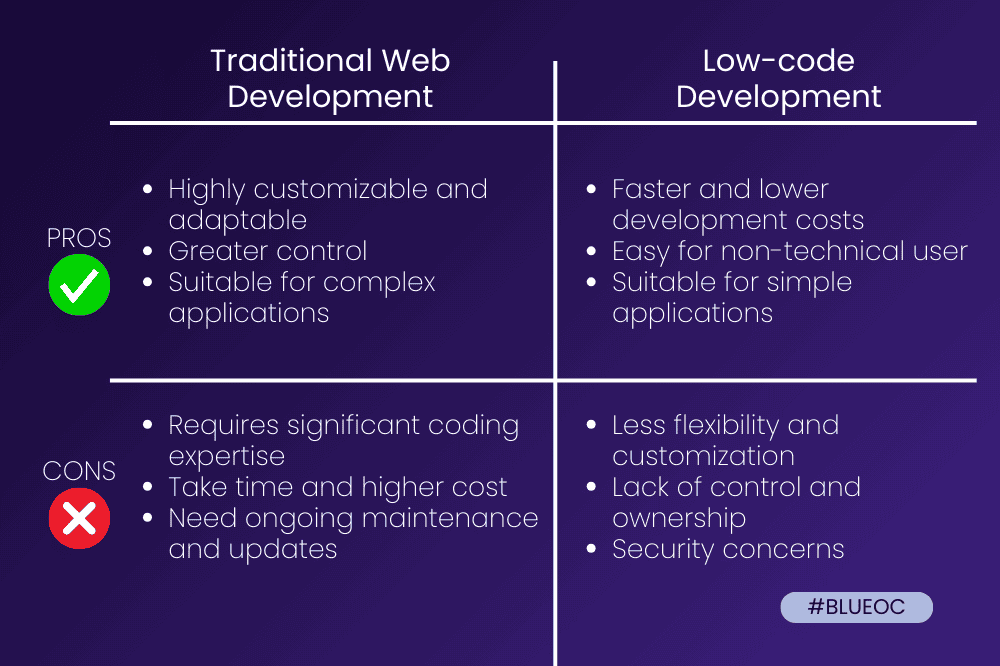
Traditional web development and low-code development each present distinct advantages and disadvantages:
3.1 Traditional Web Development
Pros:
- Highly customizable and adaptable to specific needs
- Greater control over the development process
- Suitable for complex and feature-rich applications
Cons:
- Requires significant coding expertise and resources
- Can be time-consuming and expensive
- May require ongoing maintenance and updates
3.2 Low-Code Development
Pros:
- Faster development cycles and reduced time to market
- Lower development costs due to minimal coding
- Easy to use and accessible to non-technical user
- Suitable for simple applications and rapid prototyping
Cons:
- Less flexibility and customization compared to traditional method
- May not be suitable for highly complex or integrated applications
- Reliance on pre-built components and platform limitations
4. Enterprise Solutions: Powering Business Transformation
Several enterprise-grade low-code platforms have emerged to cater to the needs of businesses seeking to streamline their web development processes. These platforms offer robust features, scalability, and security, making them suitable for large-scale projects and enterprise-level applications. Some prominent enterprise low-code solutions include Mendix, OutSystems, and Appian.
The decision between traditional web development and low-code development depends on the specific needs and priorities of the organization. For businesses with complex requirements, a custom-built web application developed through traditional methods may be the most suitable option. However, for organizations seeking rapid development, reduced costs, and accessibility for a broader range of users, low-code development offers a compelling alternative.
BlueOC boasts robust expertise in software development, particularly in web applications, whether built from scratch or developed from low-code platforms. If you're seeking a trusted IT outsourcing provider, connect with us to leverage our comprehensive services and industry-leading solutions.