Table of content
For decades, outsourcing was primarily a question of efficiency. Organizations looked beyond their local markets to access skilled engineering talent at lower costs, while software vendors competed on delivery speed, team size, and pricing. Success was often measured by whether projects were completed on time, within budget, and according to requirements. That model worked well when technology was viewed largely as a support function.
Today, however, technology sits much closer to the center of business strategy. Software shapes customer experiences, powers operations, and increasingly determines how organizations compete. At the same time, advances in artificial intelligence are accelerating product development cycles and raising expectations around innovation. In this environment, simply delivering software is no longer enough.
Organizations still care about cost, but the conversation has evolved. Increasingly, business leaders are looking for partners who can contribute ideas, navigate uncertainty, and help translate technology investments into meaningful outcomes.
The question is no longer where software gets built. The more important question is who can help a business innovate faster.
One of the biggest changes we have observed over the past decade is the role clients expect technology teams to play.
Historically, outsourced teams were often treated as external resources responsible for executing predefined requirements. Their success was measured by how accurately they followed specifications and how efficiently they delivered assigned tasks. As a result, many outsourcing relationships were inherently transactional.
Today, that expectation looks very different. As technology becomes more deeply integrated into business operations, clients increasingly expect engineering teams to contribute beyond execution. They want teams that identify risks before they become problems, challenge assumptions when necessary, and proactively recommend better approaches.
In many organizations, external technology teams are no longer viewed as vendors operating on the periphery. They are expected to function as part of the core team, sharing responsibility for both the process and the outcome.
"The biggest shift we have seen is not technological. It is a shift in expectations. Clients no longer want teams that simply follow requirements. They want partners who take ownership, think proactively, and share responsibility for outcomes. That mindset has become far more important than where the software is built."
— Mrs. Harry Vu, CEO of BlueOC Tech.
This shift is reflected in broader industry trends. Deloitte's Global Outsourcing Survey found that organizations are placing increasing emphasis on access to specialized expertise, agility, and business value creation, rather than focusing exclusively on cost reduction (Deloitte, 2024).
The implication is significant. When technology becomes a source of competitive advantage, businesses need more than additional development capacity. They need partners capable of taking ownership alongside them.
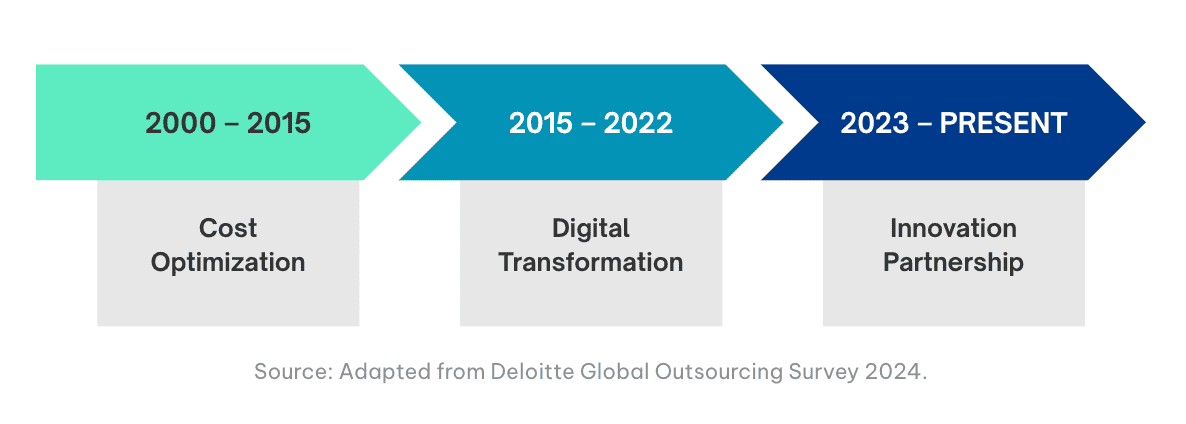
The traditional outsourcing model was built around a relatively straightforward premise. Clients defined the destination, vendors provided the resources, and success was measured by how effectively the agreed requirements were delivered.
Modern technology projects rarely operate under those conditions. Product roadmaps evolve continuously. Customer expectations shift. AI capabilities advance at an unprecedented pace. New opportunities often emerge halfway through a project, while assumptions that seemed reasonable at the beginning may no longer hold true several months later. In environments like these, requirements are often incomplete from the outset because the business itself is still discovering the most effective path forward.
As a result, the most valuable contribution a technology team can make is not always building what was originally requested. Sometimes it is helping clients redefine the problem, evaluate alternative approaches, or identify opportunities that were not visible at the start of the engagement.
This is where the distinction between a vendor and a technology partner becomes increasingly important. A vendor is primarily responsible for delivering requirements. A technology partner is invested in achieving business outcomes. While the difference may sound subtle, it fundamentally changes the nature of the relationship. Technology partners contribute domain expertise, participate in strategic discussions, challenge assumptions, identify risks, and share responsibility for success. Rather than simply delivering products, they help shape the direction those products take.
The rapid rise of AI has made one reality increasingly clear: access to technology is no longer the primary differentiator.
Today, organizations around the world can access the same foundation models, cloud infrastructure, and development tools. Yet despite this widespread availability, many companies continue to struggle to generate meaningful business value from their technology investments. According to Boston Consulting Group, 74% of organizations still face challenges in achieving and scaling value from AI initiatives (BCG, 2024).
The challenge is rarely the technology itself. More often, it lies in understanding workflows, operational constraints, industry requirements, and organizational priorities well enough to apply technology effectively. Translating technical capabilities into measurable business outcomes requires context, and context is not something that can be transferred through documentation alone. It is built through collaboration, shared experience, and a deep understanding of the business environment. That is why the most successful technology initiatives are increasingly driven by partnerships rather than transactions.
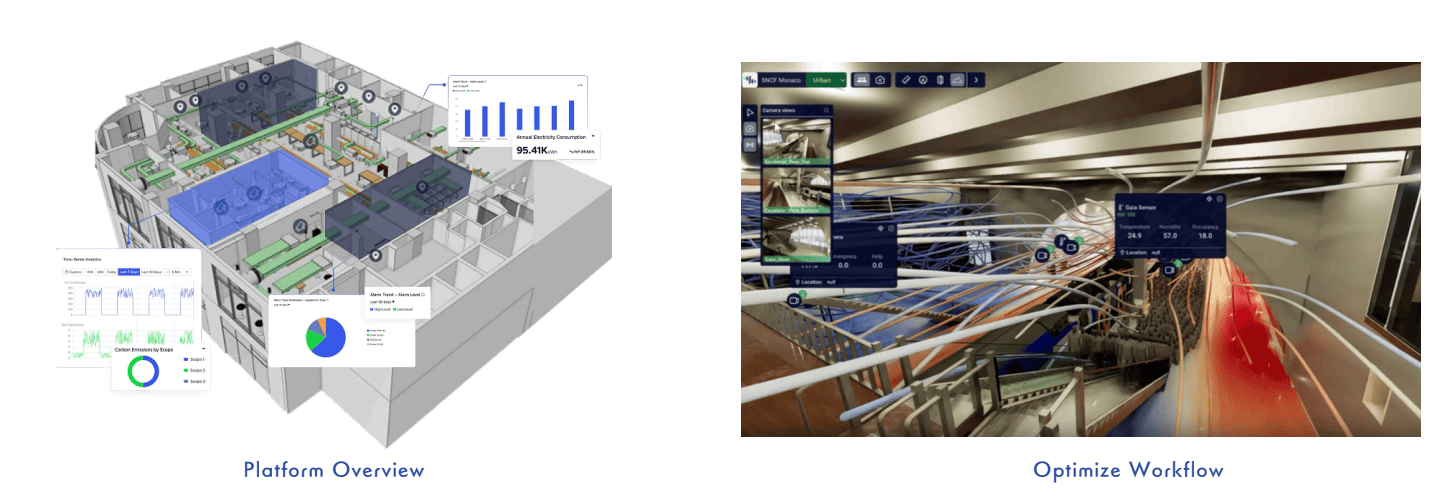
One project that continues to shape our thinking involved a client operating in the field of digital twins and large-scale 3D asset simulation. At the time, this was a relatively emerging space, not only in Vietnam but globally. There were few established implementation models, limited technical expertise available in the market, and no obvious roadmap for solving many of the challenges involved.
To be candid, we did not begin the project with complete confidence that we already had all the answers. What we did have was a willingness to learn.
Rather than limiting our involvement to a predefined scope, our team invested significant time researching unfamiliar technologies, experimenting with different approaches, and working closely with the client to understand the broader objectives behind the project. For several months, the engagement was as much about discovery and learning as it was about software development. Eventually, the project was successfully delivered. More importantly, it reinforced a belief that continues to guide how we work today.
"Some of the strongest client relationships we have built began with projects where neither side had all the answers. What mattered was a shared willingness to learn, adapt, and solve problems together. To me, that is what technology partnership really means."
— Mrs. Harry Vu, CEO of BlueOC Tech.
Technology partnership is not about having every answer on day one. It is about taking ownership of the problem, investing in understanding it, and being willing to grow alongside the client until the right solution emerges. In many ways, this mindset has become even more important as organizations begin exploring new frontiers such as AI, where uncertainty remains high and best practices are still evolving.
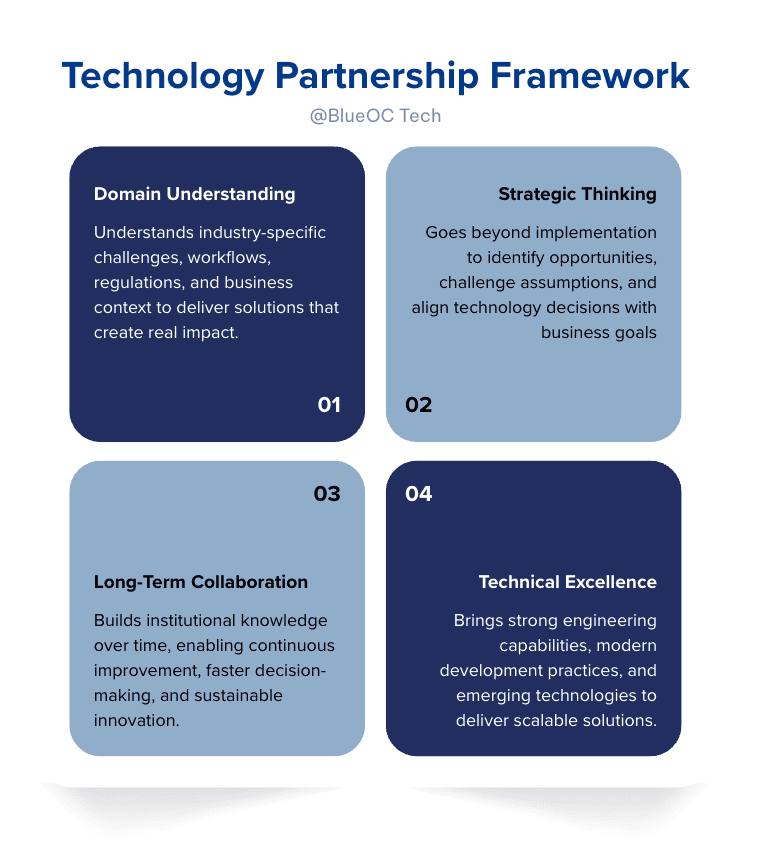
Strong technology partnerships are rarely built on technical capability alone. Over time, we have found that the most successful partnerships tend to share four characteristics.vTogether, these capabilities create the foundation for a true technology partnership.
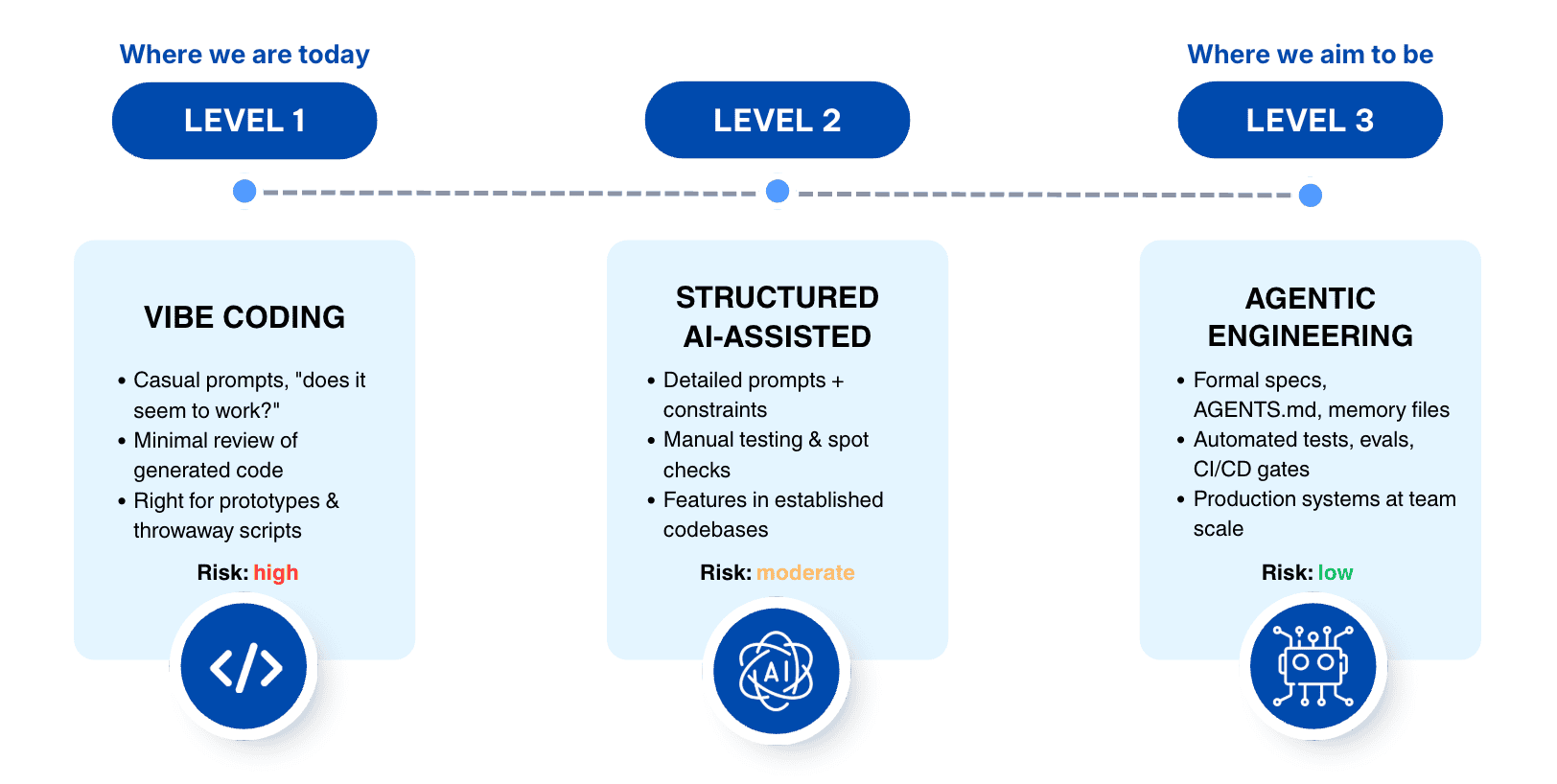
The rise of AI is creating another important shift in how technology organizations operate.
Much of today's conversation focuses on AI-assisted coding and productivity gains. While these tools are already improving efficiency, many industry leaders believe the next stage of software development will involve something more sophisticated.
Increasing attention is being placed on what some practitioners describe as Agentic Engineering. Rather than using AI solely as a coding assistant, this approach integrates AI into structured engineering workflows supported by specifications, governance frameworks, automated testing, evaluation systems, CI/CD pipelines, and human oversight.
The distinction matters because as software becomes easier to generate, the value of engineering increasingly shifts toward judgment, verification, architecture, and accountability.
In other words, the competitive advantage will not come from simply generating more code.
It will come from ensuring that code reliably creates business value.
Over the next several years, this is one direction we believe the industry will continue moving toward. Organizations that successfully combine AI capabilities with disciplined engineering practices will be better positioned to innovate without sacrificing quality, security, or reliability.
As technology becomes increasingly central to business success, the outsourcing industry will continue to evolve.
The most successful relationships will no longer be defined solely by cost efficiency or delivery capacity. They will be defined by trust, ownership, adaptability, and a shared commitment to solving meaningful business challenges.
At BlueOC, we often describe ourselves with a simple phrase:
Big enough to scale, small enough to care.
For us, this means being large enough to support ambitious technology initiatives while remaining close enough to our clients to genuinely care about the outcomes.
Because ultimately, organizations do not need another vendor.
They need a partner willing to share responsibility for innovation, navigate uncertainty together, and help transform technology into measurable business value.
That is why we believe the future of outsourcing is not defined by who can deliver software at the lowest cost.
It will be defined by who can become a trusted technology partner.