Table of content
When generative AI entered the mainstream, many organizations focused on one visible use case: the AI chatbot. Internal knowledge assistants, customer service bots, and document summarization tools became common starting points for enterprise adoption.
The conversation is beginning to change. The question is no longer whether AI can answer questions or generate content. Instead, enterprises are asking a more practical question: How can AI improve the way work is actually performed?
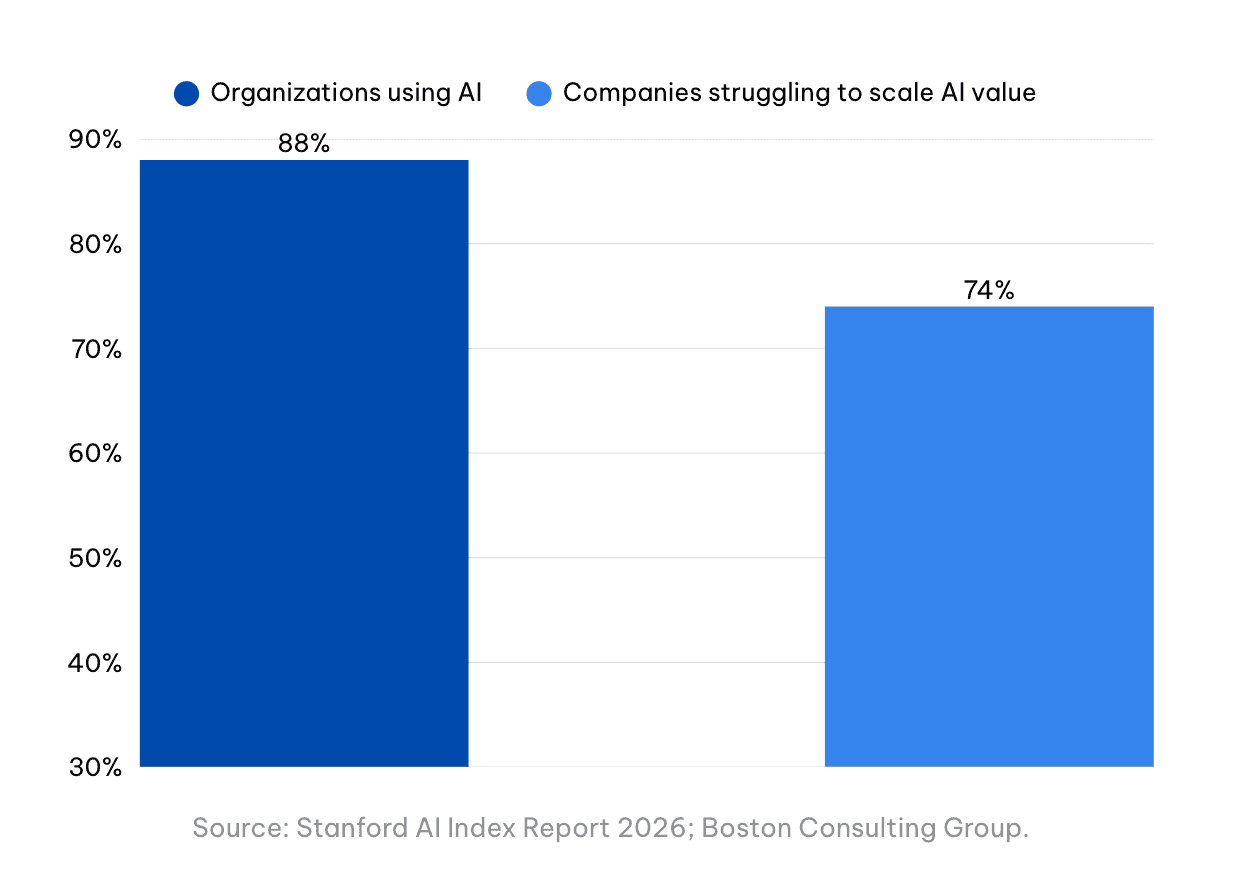
According to the Stanford AI Index Report 2026, organizational AI adoption reached 88% globally, highlighting how quickly AI has moved from experimentation to mainstream business technology. At the same time, frontier AI capabilities continue to advance rapidly. The success rate of AI agents on the OSWorld benchmark increased from around 12% to 66% within a single year, demonstrating significant progress in AI systems that can complete multi-step digital tasks.
Despite these advances, adoption alone does not guarantee business value. A global survey by Boston Consulting Group found that 74% of companies still struggle to achieve and scale meaningful value from AI initiatives. This finding points to a broader challenge. Most enterprises no longer doubt AI's technical capabilities. The difficulty lies in integrating AI into existing processes, enterprise data environments, and operational decision-making.
Conversational AI has delivered measurable benefits in areas such as customer support, knowledge management, and employee productivity. Microsoft and LinkedIn's Work Trend Index found that knowledge workers increasingly rely on generative AI to search for information, summarize content, and accelerate routine tasks.
However, many high-value business processes involve more than generating answers.
Consider a typical insurance claims workflow. Processing a claim may require collecting images, validating documentation, detecting potential fraud, estimating repair costs, reviewing historical records, and obtaining approvals across multiple systems. A chatbot may simplify access to information, but it does not address the complexity of the underlying process.
This distinction is becoming increasingly important. According to the IBM Institute for Business Value, organizations reporting the strongest return on AI investment are those embedding AI into operational workflows rather than deploying isolated productivity tools.
In practice, the competitive advantage comes less from having an AI interface and more from connecting AI to the systems where work actually happens.
Leading organizations are increasingly approaching AI adoption through the lens of workflow transformation. Instead of beginning with a technology use case, they start by identifying operational bottlenecks that create delays, manual effort, or unnecessary cost.
This approach often combines multiple AI capabilities within a single process:
Large language models to interpret and generate text.
Computer vision models to analyze images and visual evidence.
Predictive machine learning models to identify anomalies or estimate outcomes.
Workflow orchestration tools that connect AI outputs with enterprise systems and human decision-makers.
This architecture reflects a broader shift in enterprise AI strategy. In its State of AI Trust in 2026, McKinsey observes that organizations are moving beyond experimentation and beginning to deploy generative and agentic AI across core business functions.
The implication is straightforward. AI creates greater value when it becomes part of an operational workflow rather than remaining a standalone application.
Another trend shaping the next phase of enterprise AI is the emergence of agentic AI. Unlike conventional AI assistants that respond to individual prompts, AI agents can execute a sequence of tasks according to predefined objectives and governance rules.
An AI agent may retrieve information from internal systems, call external APIs, validate outputs, generate reports, and route recommendations to human reviewers. Rather than replacing people, these systems reduce the amount of repetitive coordination and administrative work required to complete a business process.
This direction is reflected in recent industry research. Gartner's Top Strategic Technology Trends 2025 identifies agentic AI as one of the technologies expected to reshape enterprise software by enabling AI systems to support increasingly autonomous execution of knowledge work.
At the same time, the rapid improvement in AI agent benchmarks suggests that these capabilities are evolving quickly enough to become commercially relevant across a growing number of enterprise scenarios.
Although AI use cases vary across industries, recent research and implementation experience point to several common characteristics shared by successful projects.
They begin with a business problem, not a technology trend. AI initiatives linked to measurable operational outcomes, such as reducing processing time or improving decision accuracy, are generally easier to scale than open-ended experimentation.
They leverage proprietary enterprise data. Foundation models are becoming increasingly accessible, but their effectiveness depends heavily on the quality of internal data and domain-specific knowledge available to the organization.
They are designed around human-AI collaboration. Many organizations are prioritizing "human-in-the-loop" operating models, particularly in industries where explainability, governance, and regulatory compliance remain critical.
This pattern is increasingly visible across sectors such as insurance, manufacturing, energy, and infrastructure, where AI augments expert decision-making rather than fully automating it.
The current trajectory of enterprise AI resembles the early evolution of cloud computing. Initially, cloud was often viewed as a standalone IT initiative. Over time, it became embedded within products, platforms, and everyday business operations.
AI appears to be following a similar path. According to McKinsey, leading organizations are increasingly "rewiring" core functions around AI capabilities instead of adding AI as a separate technology layer.
If that trend continues, enterprises may eventually stop evaluating whether they "have AI." The more meaningful question will be whether AI is integrated into the workflows that generate operational and strategic value.
The first wave of enterprise AI demonstrated that foundation models can improve access to information and individual productivity. The next phase is likely to be defined by something different: the ability to redesign business processes around AI.
From BlueOC's perspective, this shift creates a significant opportunity for enterprises. The long-term differentiator is unlikely to be access to AI models themselves, as those capabilities are becoming increasingly commoditized. Sustainable advantage will come from understanding a specific business domain, integrating AI with enterprise data, and applying it to solve operational problems that matter.